Showing posts with label Rookie of the Year Spotlight. Show all posts

Friday, July 8, 2022

Rookie of the Year Spotlight: Justin Verlander


Some of the collections I have been working on over the years are starting to get filled out and my goals are being reached. As a result, I'm starting to slow down a little when it comes to acquiring many cards for some of my mini-collections. Now that the collection is feeling more and more complete, I wanted to start showcasing the cards I have, player by player.

One such collection is my Rookie of the Year collection. I love collecting players who have won the award as the top newcomer in each league. This wasn't born of hot rookie hype and the desire to prospect. Rather, I became fascinated thinking about the careers of guys like Eric Karros, Jerome Walton, and Tim Salmon, who experienced varying degrees of success but may not have become superstars. I thought it would be fun to have a collection that chronicles the individual career journeys of rookie stars--whether they burned bright and flamed out quickly, regressed to the mean, or wended their way to Cooperstown.
 
My goal has been to fill a binder page for each player who won the award in my lifetime and to fill a row for older players. I may expand that later as I expand my vintage collection. The ultimate goal of my binder is to show a card from every different uniform the player wore, from fresh-faced rookie to grizzled vet. This series is to commemorate each Rookie of the Year's career and show my collection of their cards. I have a randomized list of winners that I use to determine the order of these posts, but for the second time in a row, I'm going away from that order. Today we highlight

Justin Verlander

Justin Verlander's Major League career got off to an inauspicious start in 2005. He started two games for the Tigers, pitched 11 innings, and allowed 9 earned runs. He came back to Detroit's rotation in 2006 to strike out 124 batters en route to winning 17 games and posting a 3.23 ERA (good for 7th in the AL). He ran away with the AL Rookie of the Year award, taking all but two first place votes (Minnesota's Francisco Liriano and Baltimore's Nick Markakis) and finishing 70 points ahead of second-place finisher Jonathan Papelbon, who saved 35 games for the Red Sox. Besides winning ROY, Verlander finished 7th in the AL Cy Young balloting and even garnered some MVP votes.

Since then, Verlander has put together a first-ballot Hall of Fame career as a generational starting pitcher. During his time in Detroit, he received six All-Star nominations. In 2011, he took home the AL pitching Triple Crown with a 2.40 ERA, 24 wins, and 250 strikeouts. He also led the league with a minuscule .920 WHIP across 250 innings. He won the Cy Young Award unanimously that year and became just the 10th pitcher to win the Cy Young and MVP in the same season (the first to do it since Dennis Eckersley in 1992). 

He was traded to the Houston Astros in 2017 as part of their pennant push, and saying it paid off would be an understatement. After arriving in Houston, he pitched in five regular season games, going 5-0 with a 1.06 ERA and 43 strikeouts. He posted an incredible 8.6 SO/W ratio for the Astros before winning ALCS MVP and helping the team win the World Series. Then he just seemed to get better, finishing second in the Cy Young voting the next season before winning his second award in 2019. Tommy John kept him out all of 2021, but he has come back strong in 2022 with a 2.03 ERA and an AL-best 10 wins as the All-Star Break approaches.

This is the first spotlight that has come up of an active player, so this career wrap-up is incomplete. Incomplete, yet impressive. As of this writing, he has led the league in ERA once, strikeouts five times, WHIP four times, innings pitched four times, and wins three times. He is the current active leader with 3,103 strikeouts and currently sits and #16 on the all-time leaderboard.

The scans above don't show all of the Justin Verlander cards in my collection, but the ones I didn't show are all part of set builds. These are the ones that are part of my Rookie of the Year collection, enough for a nice, even, double-bagged page.


Wednesday, July 6, 2022

Rookie of the Year Spotlight: Todd Worrell

Some of the collections I have been working on over the years are starting to get filled out and my goals are being reached. As a result, I'm starting to slow down a little when it comes to acquiring many cards for some of my mini-collections. Now that the collection is feeling more and more complete, I wanted to start showcasing the cards I have, player by player.

One such collection is my Rookie of the Year collection. I love collecting players who have won the award as the top newcomer in each league. This wasn't born of hot rookie hype and the desire to prospect. Rather, I became fascinated thinking about the careers of guys like Eric Karros, Jerome Walton, and Tim Salmon, who experienced varying degrees of success but may not have become superstars. I thought it would be fun to have a collection that chronicles the individual career journeys of rookie stars--whether they burned bright and flamed out quickly, regressed to the mean, or wended their way to Cooperstown.
 
My goal has been to fill a binder page for each player who won the award in my lifetime and to fill a row for older players. I may expand that later as I expand my vintage collection. The ultimate goal of my binder is to show a card from every different uniform the player wore, from fresh-faced rookie to grizzled vet. This series is to commemorate each Rookie of the Year's career and show my collection of their cards. I have a randomized list of winners that I use to determine the order of these posts, but for the second time in a row, I'm going away from that order. Today we highlight

Todd Worrell


Todd Worrell saw his first Big League action in 1984. He made 17 relief appearances and recorded a solid 2.91 ERA with a 1.11 WHIP. With his rookie status still in place in 1985, Worrell became the Cardinals' closer. That season, he pitched 103 2/3 innings in 74 games. He led the NL with 36 saves and lowered his ERA to 2.08. Not only did he beat out a loaded NL rookie field that included Barry Bonds, Barry Larkin, Will Clark, John Kruk, and Kevin Mitchell, but he absolutely ran away with the award. He received all but one 1st-place vote. (The lone straggler vote went to Kevin Mitchell, who finished fourth.) Worrell was by no means a bad pick, but in hindsight he was a surprise. Using today's metrics, he might not have one. His 2.6 WAR was good, but was fourth-best behind Bonds (3.5), Robby Thompson (3.4), and Bruce Ruffin (3.2).

Over the next six seasons with St. Louis, Worrell kept his ERA under 3.00. from 1986-1989, he remained the Cardinals' closer. He earned his first All-Star bid in 1988 en route to a 32-save season. Tommy John surgery and a torn rotator cuff kept him on the shelf for all of the 1990 and 1991 seasons. He returned out of the bullpen in 1992, but not in the closer role. Still, he was solid. He signed with the Dodgers as a free agent and served as a middle reliever in 1993 and 1994. In 1995, he regained the closer role, which he would hold through the end of his career after the 1997 season. As the Dodgers' closer, he saved 32, 44, and 35 games from 1995-1997. He made two more All-Star teams in 1995 and 1996, and his save total in 1996 led the league. 


In 11 Major League seasons, Worrell pitched 693 2/3 frames, finishing 456 games and earning 256 saves. His career ERA was 3.09. He struck out 628 batters to 247 walks and held opponents to a .235 batting average. He even received MVP votes in two seasons (1985 and 1996) and finished fifth in the NL Cy Young voting in 1996. A good career, to be sure, but far from elite. In 2003, his first and only year on the Hall of Fame ballot, Worrell failed to receive a vote.

Since he spent his entire career with just two teams, it was easy enough to complete the run for Todd Worrell. The first page shown was all I needed for my binder. The second scan is just gravy. I'll keep any Worrell cards I come across, but I'm no longer actively seeking them now that his portion of my binder is complete.

Friday, July 1, 2022

Rookie of the Year Spotlight: Tommy Helms

Some of the collections I have been working on over the years are starting to get filled out and my goals are being reached. As a result, I'm starting to slow down a little when it comes to acquiring many cards for some of my mini-collections. Now that the collection is feeling more and more complete, I wanted to start showcasing the cards I have, player by player.
 
One such collection is my Rookie of the Year collection. I love collecting players who have won the award as the top newcomer in each league. This wasn't born of hot rookie hype and the desire to prospect. Rather, I became fascinated thinking about the careers of guys like Eric Karros, Jerome Walton, and Tim Salmon, who experienced varying degrees of success but may not have become superstars. I thought it would be fun to have a collection that chronicles the individual career journeys of rookie stars--whether they burned bright and flamed out quickly, regressed to the mean, or wended their way to Cooperstown.
 

My goal has been to fill a binder page for each player who won the award in my lifetime and to fill a row for older players. I may expand that later as I expand my vintage collection. The ultimate goal of my binder is to show a card from every different uniform the player wore, from fresh-faced rookie to grizzled vet. This series is to commemorate each Rookie of the Year's career and show my collection of their cards. I have a randomized list of winners that I use to determine the order of these posts, but for the second time in a row, I'm going away from that order. Today we highlight

Tommy Helms


In 1964, Tommy Helms got his first cup of coffee, appearing in two games for the Reds after his call-up. The next season, he made 21 more appearances. In 1966, he was in the Big Leagues to stay as the Reds' primary 3rd baseman. During his first full season, he batted .284 and showed the most pop that he would show for his entire career: 9 HR and .380 slugging. His fielding percentage at the hot corner was .961, good for fourth in the Majors. It increased to .969 when considering his time at SS. Helms defeated Houston SS Sonny Jackson in the Rookie of the Year voting, gaining 60% of the votes.

 
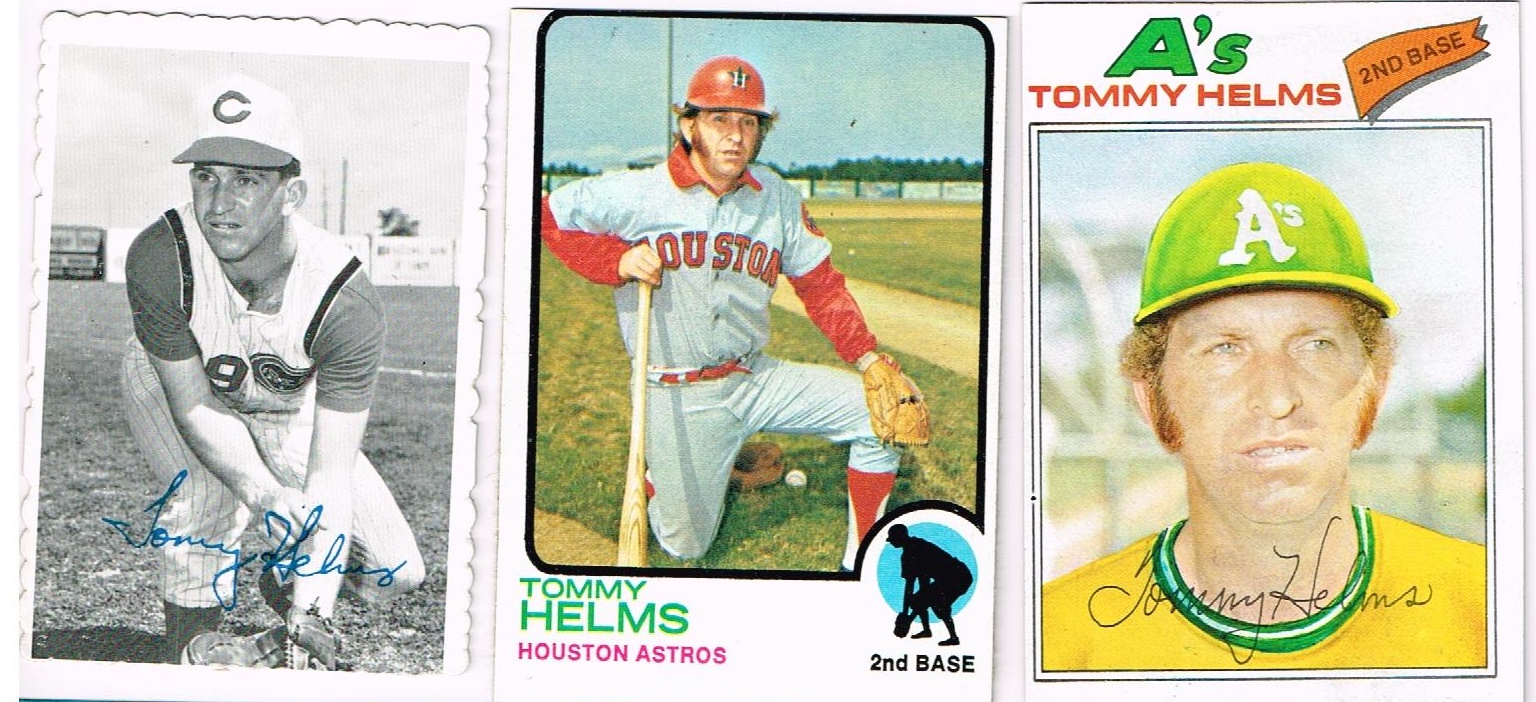
The next year, in 1967, Cincinnati moved Helms to 2nd base. The move seemed to pay off, as Helms made the NL All-Star teams in two consecutive years, 1967-1968. Then in 1970-1971, Helms won the Gold glove at 2nd base. 1971 was his best season; he finished second in the MLB with a .990 fielding percentage and posted a 2.7 WAR. Following the season, Helms was sent to Houston as part of the trade that brought the legendary Joe Morgan to Cincinnati. Helms was the Astros' primary second bagger for the next three seasons, but by 1975--his fourth in Houston--he was settling into a part-time role. He spent 1976 in Pittsburgh after being traded for a player to be named later (Art Howe). After one season with the Pirates, he was traded to Oakland along with Phil Garner for six players, including Tony Armas, Doc Medich, and Dave Giusti. A year later he was released by the Pirates, signed with Red Sox, and his career came to after a year in Boston.
 
During his career, Helms was a slick fielder who finished in the top 10 in fielding percentage in eight of his nine seasons as a starter. He won two Gold Gloves and received two All-Star nods. His bat was somewhat weak, as he finished with a career OPS of .642. His career WAR was 8.6.

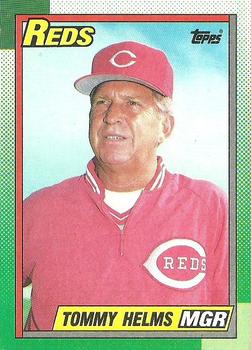
1990 Topps #110 Tommy Helms Front
 
After his playing career, Helms entered coaching. He returned to Cincinnati and managed the Reds in place of the embattled Pete Rose for 64 games in 1988 and 1989. He won 12 of 27 in 1988 and 16 of 37 in 1989. He failed to obtain the full-time job in 1990, when the team won the World Series under skipper Lou Piniella.

Friday, November 5, 2021

Rookie of the Year Spotlight: Buster Posey

Some of the collections I have been working on over the years are starting to get filled out and my goals are being reached. As a result, I'm starting to slow down a little when it comes to acquiring many cards for some of my mini-collections. Now that the collection is feeling more and more complete, I wanted to start showcasing the cards I have, player by player.

One such collection is my Rookie of the Year collection. I love collecting players who have won the award as the top newcomer in each league. This wasn't born of hot rookie hype and the desire to prospect. Rather, I became fascinated thinking about the careers of guys like Eric Karros, Jerome Walton, and Tim Salmon, who experienced varying degrees of success but may not have become superstars. I thought it would be fun to have a collection that chronicles the individual career journeys of rookie stars--whether they burned bright and flamed out quickly, regressed to the mean, or wended their way to Cooperstown.
 
My goal has been to fill a binder page for each player who won the award in my lifetime and to fill a row for older players. I may expand that later as I expand my vintage collection. The ultimate goal of my binder is to show a card from every different uniform the player wore, from fresh-faced rookie to grizzled vet. This series is to commemorate each Rookie of the Year's career and show my collection of their cards. I have a randomized list of winners that I use to determine the order of these posts, but I'm going off-script today to honor a recently retired former Rookie of the Year.
 

Buster Posey

Gerald Posey got his first cup of coffee in 2009, appearing in seven games and batting .185. The next year, he became the Giants' full-time backstop. In 2010, he led NL rookies with a .305 batting average and finished tied for second in home runs (18, one behind Florida's Gaby Sanchez). He also got to play in  six postseason games as the Giants won the World Series. The postseason success may have played a role in pushing him to the top of the Rookie of the Year voting. He ended up receiving 20 first-place votes over fellow rookie sensation Jason Heyward and his nine. St. Louis pitcher Jaime Garcia finished third, receiving one first-place vote, and Gaby Sanchez finished fourth but received two first-place votes.

2010 was just the beginning for Posey, however. Even though he missed most of the following season, he still managed to change baseball forever. During a play at the plate collision with Florida's Scott Cousins, Posey badly broke his leg. The play contributed to a new rule disallowing catchers to block the plate and runners to initiate contact with the catcher. The rule came to be known as "The Buster Posey Rule." But it wasn't just this unfortunate occurrence that made Posey's career memorable. In 2012, Posey returned and had a career year. He set career highs in average (an MLB-leading .336), home runs (24), RBI (103), and OPS (.957). His 171 OPS+ led the Majors. Posey took home NL MVP and received his second World Series ring. Over the next six seasons, Posey would make five All-Star teams. The one year he didn't get All-Star honors (2014), he still finished sixth in the MVP voting. He failed to make the All-Star team in 2019 and opted out of the 2020 season, but came back strong in 2021. This past year he led the Giants to the best regular season record in baseball and received one last All-Star nod.

Now Posey is hanging them up after 12 MLB seasons. He'll retire with seven All-Star nominations, three World Series rings, a Gold Glove, four Silver Sluggers, and an MVP. His career slash line is .302/.372/.460. Every game he played was in a Giants uniform. During his playing time, he was arguably the best catcher of his generation, going toe-to-toe with Yadier Molina for that honor. Without a doubt, he will find himself in Cooperstown when he is eligible. I'd say the Giants got what they wanted when they selected him 5th overall in the 2008 draft.

I have more Posey cards than this, but these are all I have in my ROY collection. Many of my other Poseys are parts of my set builds. In all, I have 37 Buster Posey cards. I don't need to chase down any other teams for him because he spent his entire career as a Giant. Congrats on the outstanding career, Buster!

Friday, September 24, 2021

Rookie of the Year Spotlight: Bob Hamelin

Some of the collections I have been working on over the years are starting to get filled out and my goals are being reached. As a result, I'm starting to slow down a little when it comes to acquiring many cards for some of my mini-collections. Now that the collection is feeling more and more complete, I wanted to start showcasing the cards I have, player by player.

One such collection is my Rookie of the Year collection. I love collecting players who have won the award as the top newcomer in each league. This wasn't born of hot rookie hype and the desire to prospect. Rather, I became fascinated thinking about the careers of guys like Eric Karros, Jerome Walton, and Tim Salmon, who experienced varying degrees of success but may not have become superstars. I thought it would be fun to have a collection that chronicles the individual career journeys of rookie stars--whether they burned bright and flamed out quickly, regressed to the mean, or wended their way to Cooperstown.
 
My goal has been to fill a binder page for each player who won the award in my lifetime and to fill a row for older players. I may expand that later as I expand my vintage collection. The ultimate goal of my binder is to show a card from every different uniform the player wore, from fresh-faced rookie to grizzled vet. This series is to commemorate each Rookie of the Year's career and show my collection of their cards. I placed all of the past winners into random.org and got my order. The next player up is:
 

Bob Hamelin


After toiling in the minor leagues for six years, former second-round pick Bob Hamelin got the call to the Majors in 1993. In his first taste of the Bigs, he made 55 plate appearances in 16 games. The results were underwhelming; he slashed .224/.309/.408 with two home runs and 15 strikeouts. In 1994, he was markedly better. He improved his average to .282 and started slugging a few homers. He hit 24 dingers in his first full season, increasing his slugging percentage 191 points and posting a healthy .987 OPS before a strike cut the season short. He won the American League Rookie of the Year easily, taking home 25 of 28 first-place votes. The remaining three first-place votes went to Rusty Greer, who finished third. Sandwiched between them was Cleveland outfielder Manny Ramirez.

Ironically, the 101 games of the strike-shortened season would be the most he would play in a season for the Royals. Over the next two seasons with the club, he would play almost one full slate of games: 161. After a horrendous start to 1995, slashing .168/.278/.313, he was sent back to AAA Omaha. 1996 wasn't much better. After winning ROY, slugger Bob Hamelin would only hit 16 more home runs for KC. He was released during Spring Training in 1997.


He signed with Detroit a month later and bounced back somewhat with the Tigers. He had his best season post-rookie year in 1997, hitting .270 with 18 homers in 110 games. The next year he signed with the Brewers and slumped again. As Milwaukee's regular DH, he put up a paltry .699 OPS with seven home runs. In 1999, he was back in the minors with the Tigers organization when he decided to hang 'em up.
 
Hamelin was a bit of a cult hero during his rookie season, probably due to the fact that he didn't look the part of elite athlete. He looks more likely to finish his shift at the plant and knock back a couple of cold ones while watching the game than to hit home runs on the field at said game. In six Major League seasons, he hit .246 with 67 HR and 209 RBI. Baseball-Reference gives him a WAR of 2.5. It's players like Hamelin that make my ROY collection interesting to me. A player that otherwise would have been largely forgotten by history has one shining breakthrough season and gets the spotlight. The subsequent and varying career trajectories are fascinating to me.

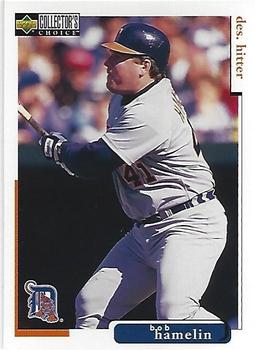
1998 Collector's Choice #89 Bob Hamelin Front

Since I scanned these cards, I've added this Tigers card to my Bob Hamelin page. I still need one to rep the Brewers and complete his career documentation in my collection.

Friday, September 3, 2021

Rookie of the Year Spotlight: Jeremy Hellickson

Some of the collections I have been working on over the years are starting to get filled out and my goals are being reached. As a result, I'm starting to slow down a little when it comes to acquiring many cards for some of my mini-collections. Now that the collection is feeling more and more complete, I wanted to start showcasing the cards I have, player by player.

One such collection is my Rookie of the Year collection. I love collecting players who have won the award as the top newcomer in each league. This wasn't born of hot rookie hype and the desire to prospect. Rather, I became fascinated thinking about the careers of guys like Eric Karros, Jerome Walton, and Tim Salmon, who experienced varying degrees of success but may not have become superstars. I thought it would be fun to have a collection that chronicles the individual career journeys of rookie stars--whether they burned bright and flamed out quickly, regressed to the mean, or wended their way to Cooperstown.
 
My goal has been to fill a binder page for each player who won the award in my lifetime and to fill a row for older players. I may expand that later as I expand my vintage collection. The ultimate goal of my binder is to show a card from every different uniform the player wore, from fresh-faced rookie to grizzled vet. This series is to commemorate each Rookie of the Year's career and show my collection of their cards. I placed all of the past winners into random.org and got my order. The next player up is:
 

Jeremy Hellickson

This is the Hellickson page in my ROY binder.

A former 4th-round pick of the Tampa Bay Rays in 2005, Jeremy Hellickson got his first taste of Major League action in 2010. In that first cup of coffee, Hellickson made 4 starts of the 10 games he played, pitching 36.1 innings and finishing with a 4-0 record. The impressive debut meant that he was going to stick around for the 2011 season. He did not disappoint in his first full season. In 2011, he started 29 games, pitching 189 innings. He struck out 117 batters, recorded a 2.95 ERA and a 1.15 WHIP. He took home AL Rookie of the Year honors comfortably, collecting 17 of the 28 first place votes. Second place went to Mark Trumbo, who received 5 first place votes, followed by Eric Hosmer with 4. Evan Nova and Dustin Ackley both received a single vote apiece.

Interestingly, Hellickson's stats simultaneously improved and regressed in the coming years. Moving on from his rookie season, he improved both his strikeout and walk rates, while his ERA and WHIP both climbed. He also won a Gold Glove award in 2012. He spent five years in Tampa Bay before Arizona traded Andrew Velasquez and Justin Williams for his services in the offseason following the 2014 season. He played one season for the D-Backs, starting 27 games before being traded again. One year to the day after joining Arizona, he was shipped again. This time, he was traded to the Phillies for Sam McWilliams. He spent two seasons in Philadelphia, having arguably his best season since his rookie year in 2016. That season he matched his career-high in innings, had a sub-four ERA for the first time since 2012, and recorded his highest strikeout total (154) and K/BB ratio (3.42) in his career. The next season, he regressed and was dealt at the trade deadline to Baltimore for Garrett Cleavinger and Hyun Soo Kim. His time in Baltimore did not go well and at the end of the season, Hellickson was on the move again. This time, he signed a free agent contract with the Washington Nationals. He started 27 games for the Nats in 2018 and 2019, posting a 4.28 ERA and 1.27 WHIP. He has not played since 2019.

In all, he appeared in 232 games, starting 224 of them. He had a career 4.13 ERA and 929 strikeouts. He pitched two complete game shutouts. In 10 seasons, he was a serviceable rotation starter for five teams, won two awards (ROY and Gold Glove), but never was an All-Star or received any Cy Young votes. I have a card representing his time with all five teams.

I hope you are enjoying this series. I plan to keep it going until I've covered all of the MLB Rookie Award Winners.

Monday, July 26, 2021

Rookie of the Year Spotlight: Albie Pearson

Some of the collections I have been working on over the years are starting to get filled out and my goals are being reached. As a result, I'm starting to slow down a little when it comes to acquiring many cards for some of my mini-collections. Now that the collection is filling more and more complete, I wanted to start showcasing the cards I have, player by player.
 
One such collection is my Rookie of the Year collection. I love collecting players who have won the award as the top newcomer in each league. This wasn't born of hot rookie hype and the desire to prospect. Rather, I became fascinated thinking about the careers of guys like Eric Karros, Jerome Walton, and Tim Salmon, who experienced varying degrees of success but may not have become superstars. I thought it would be fun to have a collection that chronicles the individual career journeys of rookie stars--whether they burned bright and flamed out quickly, regressed to the mean, or wended their way to Cooperstown.
 
My goal has been to fill a binder page for each player who won the award in my lifetime and to fill a row for older players. I may expand that later as I expand my vintage collection. The ultimate goal of my binder is to show a card from every different uniform the player wore, from fresh-faced rookie to grizzled vet. This series is to commemorate each Rookie of the Year's career and show my collection of their cards. I placed all of the past winners into random.org and got my order. The next player up is:
 

Albie Pearson

So the first two top rookies called up by the randomizer are winners from the 1950s who I've never seen play. Albie Pearson won the award in 1958 while with the Washington Senators. He batted .275 in his freshman season, knocking 25 doubles and three home runs. He hit 33 RBI, walked 64 times, and struck out 31 times. As the team's regular centerfielder, he finished his rookie season second in the league in outfield putouts.

Following up his Rookie of the Year performance, Pearson dropped off a bit. He was traded to Baltimore halfway through his second season. After hitting .264 in 128 games for the Orioles, Pearson was taken with the fourth pick in the 1960 expansion draft, joining the Angels for their inaugural season.

He played the best seasons of his career in California. In six seasons, he compiled a 13.1 WAR and made one All-Star appearance, in 1963. In his All-Star season, he batted a career-high .304, good for third in the league. The same year, he finished second in putouts as an outfielder. He also led the league in runs scored the year before.

After the 1966 season, his career came to an end. In all, he played 988 games over nine seasons for three teams. The 1961 Topps card above is my only Pearson card. I still need one each representing the Senators and the Orioles.

Friday, June 25, 2021

Rookie of the Year Spotlight: Harvey Kuenn

Some of the collections I have been working on over the years are starting to get filled out and my goals are being reached. As a result, I'm starting to slow down a little when it comes to acquiring many cards for some of my mini-collections. Now that the collection is filling more and more complete, I wanted to start showcasing the cards I have, player by player.
 
One such collection is my Rookie of the Year collection. I love collecting players who have won the award as the top newcomer in each league. This wasn't born of hot rookie hype and the desire to prospect. Rather, I became fascinated thinking about the careers of guys like Eric Karros, Jerome Walton, and Tim Salmon, who experienced varying degrees of success but may not have become superstars. I thought it would be fun to have a collection that chronicles the individual career journeys of rookie stars--whether they burned bright and flamed out quickly, regressed to the mean, or wended their way to Cooperstown.
 
My goal has been to fill a binder page for each player who won the award in my lifetime and to fill a row for older players. I may expand that later as I expand my vintage collection. The ultimate goal of my binder is to show a card from every different uniform the player wore, from fresh-faced rookie to grizzled vet. This series is to commemorate each Rookie of the Year's career and show my collection of their cards. I placed all of the past winners into random.org and got my order. The first player up is:

Harvey Kuenn


Harvey Kuenn made his Major League debut in 1953, playing in 19 games for the Tigers. The next year, he became the club's regular shortstop. He made an immediate impact, leading the league in plate appearances and hits while batting .308. He made the first of eight consecutive All-Star games in his rookie season.

Kuenn ran away with the Rookie of the Year award. He received 23 of 24 votes; the lone vote for another player went to Boston outfielder Tom Umphlett.

For his career, Kuenn played 15 seasons for 5 teams. He spent his first 8 seasons with Detroit, making the All-Star team in every one of them except his 19-game cup of coffee in 1953. Before the 1960 season began, he was traded to the Indians for Rocky Colavito. He spent only one year in Cleveland, making another All-Star team while batting .308 again. The next year he was on the move again, this time being traded to San Francisco for Johnny Antonelli and Willie Kirkland. He appeared in 515 games over five seasons for the Giants before being shipped to the Cubs in a mid-season trade. By this time, his bat was in decline. At the time of his trade to Chicago, the career .304 (to that point) hitter was batting a measly .237. That season, he played fewer than 100 games for the first time in his career, and he would never reach that milestone again. The Phillies bought his contract in 1966, and he finished his career that season in Philadelphia. Kuenn led the league in hits four times, doubles three times, and batting average once (a .353 mark in 1959). Baseball Reference gives him a career WAR of 26.0.

After his playing career, Kuenn went on to manage the Brewers in 1982 and 1983, not counting one game as manager in 1975. He posted a career record of 160-118 and won the AL pennant in 1982.

The three cards above are not the only ones I have of Harvey Kuenn. His 1966 Topps card is in my Cubs binder. To fully chronicle his career in my ROY binder, I still need another Cubs card, along with the Indians, Giants, and Phillies.

I hope you enjoyed this post. I plan to highlight each Rookie of the Year winner through the course of this series.