Wednesday, November 10, 2021

Ain't No Break Like a Nacho Break

Last year, our principal decided to take advantage of the modified school schedule the school board gave us. He took the Wednesdays we suddenly had with no students in the building and instituted "Nacho Wednesday." Every Wednesday, we had Crock Pots full of nacho cheese sauce and bags of tortilla chips in the faculty room. I will never pass up nacho cheese. Seriously, my wife once bought me a #10 can of nacho cheese from Costco as a Valentine's gift. Thanks to Nacho Wednesdays at work, my wife has started to refer to my growing belly as my "nachos." I'm not complaining. I'm also not complaining that this year--though we're back to a normal schedule--the principal decided to keep Nacho Wednesday. So I sit here writing this post after taking a nacho break. Hence, the topic of my post today: Nacho(s Grande) Breaks.

I haven't done many team breaks of late because I've been more focused on different aspects of my collection lately. Well, that and it seems like the Cubs are already taken whenever I see Nacho's posts. But I got in on his recent Chrome break and asked him to send the stack that I had reserved for who knows how long.

There were only four Cubs in that box. Two of them were two different refractor types of Brailyn Marquez. Marquez only has 2/3 inning pitched in the Majors, in which he gave up 3 walks, 2 hits, and 5 earned runs. But, hey, these cards are cool! He was also the 6th youngest player in the NL this season, according to Baseball-Reference, so there is time for some growth and development.


At one point, I also bought into a 2020 A&G break from Chris.


I love these non-base cards from that break The Longball Lore set is especially appealing to me. I also picked up the Brewers in this break, so if you are interested in a Christian Yelich Longball card or a couple of Milwaukee minis, I have some for trade.


And I got the Cubs from this year's Heritage, imitating the funky 1972 Topps set. This is the problem with collecting Cubs right now: only three of these players still play their home games at Wrigley Field--and one of these is in a Padres uni on the card. Interestingly, #1 and #2 on the Pitching Leaders card were traded for each other last offseason. And the third won a World Series.
 
A few extra Nacho throw-ins (possibly a Stadium Club break? I can't even remember) brought me these Cubs from yesteryear. A new Kerry Wood is always welcome in my binders.


I feel pretty certain that the only reason I bought into a 2021 Opening Day break was to get one of the last cards I needed for the Outstanding Opening Day insert set. Well, mission accomplished. I have just two more on my wantlist (Giancarlo Stanton and Hank Aaron, if you can help out with that).

Up til now, there hasn't been too much exciting stuff in this haul. Where I really lucked out was the box toppers, where I picked up Javy Baez from both 2020 A&G and 2021 Heritage. That's not too bad! I love this picture, though, with four different sizes of Baez cards. Pretty sweet, I think.

Thanks for the breaks, Chris! Nacho breaks really are the best.


Friday, November 5, 2021

Rookie of the Year Spotlight: Buster Posey

Some of the collections I have been working on over the years are starting to get filled out and my goals are being reached. As a result, I'm starting to slow down a little when it comes to acquiring many cards for some of my mini-collections. Now that the collection is feeling more and more complete, I wanted to start showcasing the cards I have, player by player.

One such collection is my Rookie of the Year collection. I love collecting players who have won the award as the top newcomer in each league. This wasn't born of hot rookie hype and the desire to prospect. Rather, I became fascinated thinking about the careers of guys like Eric Karros, Jerome Walton, and Tim Salmon, who experienced varying degrees of success but may not have become superstars. I thought it would be fun to have a collection that chronicles the individual career journeys of rookie stars--whether they burned bright and flamed out quickly, regressed to the mean, or wended their way to Cooperstown.
 
My goal has been to fill a binder page for each player who won the award in my lifetime and to fill a row for older players. I may expand that later as I expand my vintage collection. The ultimate goal of my binder is to show a card from every different uniform the player wore, from fresh-faced rookie to grizzled vet. This series is to commemorate each Rookie of the Year's career and show my collection of their cards. I have a randomized list of winners that I use to determine the order of these posts, but I'm going off-script today to honor a recently retired former Rookie of the Year.
 

Buster Posey

Gerald Posey got his first cup of coffee in 2009, appearing in seven games and batting .185. The next year, he became the Giants' full-time backstop. In 2010, he led NL rookies with a .305 batting average and finished tied for second in home runs (18, one behind Florida's Gaby Sanchez). He also got to play in  six postseason games as the Giants won the World Series. The postseason success may have played a role in pushing him to the top of the Rookie of the Year voting. He ended up receiving 20 first-place votes over fellow rookie sensation Jason Heyward and his nine. St. Louis pitcher Jaime Garcia finished third, receiving one first-place vote, and Gaby Sanchez finished fourth but received two first-place votes.

2010 was just the beginning for Posey, however. Even though he missed most of the following season, he still managed to change baseball forever. During a play at the plate collision with Florida's Scott Cousins, Posey badly broke his leg. The play contributed to a new rule disallowing catchers to block the plate and runners to initiate contact with the catcher. The rule came to be known as "The Buster Posey Rule." But it wasn't just this unfortunate occurrence that made Posey's career memorable. In 2012, Posey returned and had a career year. He set career highs in average (an MLB-leading .336), home runs (24), RBI (103), and OPS (.957). His 171 OPS+ led the Majors. Posey took home NL MVP and received his second World Series ring. Over the next six seasons, Posey would make five All-Star teams. The one year he didn't get All-Star honors (2014), he still finished sixth in the MVP voting. He failed to make the All-Star team in 2019 and opted out of the 2020 season, but came back strong in 2021. This past year he led the Giants to the best regular season record in baseball and received one last All-Star nod.

Now Posey is hanging them up after 12 MLB seasons. He'll retire with seven All-Star nominations, three World Series rings, a Gold Glove, four Silver Sluggers, and an MVP. His career slash line is .302/.372/.460. Every game he played was in a Giants uniform. During his playing time, he was arguably the best catcher of his generation, going toe-to-toe with Yadier Molina for that honor. Without a doubt, he will find himself in Cooperstown when he is eligible. I'd say the Giants got what they wanted when they selected him 5th overall in the 2008 draft.

I have more Posey cards than this, but these are all I have in my ROY collection. Many of my other Poseys are parts of my set builds. In all, I have 37 Buster Posey cards. I don't need to chase down any other teams for him because he spent his entire career as a Giant. Congrats on the outstanding career, Buster!

Monday, October 18, 2021

Pack War: 2021 Donruss

Folks, I can't believe it, but I've found more 2021 football cards at the local Walmart! This is only the second time since the pandemic hit. I picked up three jumbo packs of Donruss football last week. I don't typically love Donruss base cards, but the inserts are often interesting. These are probably just one-off packs, so I was just hoping to get some good cards to fit my collection. We'll take a look at these three packs in competition.

Each pack came with base, three rookies, three or four SP photo variations, four blue Press Proofs, and an insert or two.

Base Cards

Pack 1

Pack 2

Pack 3

The way I'm scoring this is just rank order. Pack 2 is weak here, with Tiki Barber as the legend and two defenders I don't collect in the top of the most desirable base cards. Pack 1 has Brady and Namath, one of the hottest of today's QBs in Josh Allen, and two members of the 2010s All-Decade team. (Side note: why is the Patriot legend card Brady when he is still active and has a card with a different team? Odd choice.) But legend Brett Favre, three All-Decade performers, a Heisman winner, and one more Packer give Pack 3 the win.

Base Scores: Pack 3=3
                      Pack 1=2
                      Pack 2=1 
 

 Rookies
Pack 1

Pack 2

Pack 3

Nothing great here. The biggest name is obviously Justin Fields, but that doesn't necessarily sway this Packers fan. But looking at the other rookies, there is only one other first rounder (Jamin Davis). He is paired with late-round Packer pick Kylin Hill, but I don't know if the two of them together overcome Fields. Pack 1 features two second-rounders. Here's how I would score it.
 
Rookie Scores: Pack 2=3
                         Pack 3=2
                         Pack 1=1 


SP Photo Variations

Pack 1

Pack 2

Pack 3
 
The SPs are kind of lame. There are 50 in the set, and pretty much all of them are helmetless photos. They're all pretty big names, though. Let's break these down. Pack 1 has three cards for my collection: Manning, Hopkins, and Gronk, with Manning the big one for me. Pack 2 has two cards I'll add to my collection, and Davante Adams is the biggie. Pack 3 has three for my official collections (Moss and Brady), but my favorite card is Brees in a ballcap, so that one is a keeper, too. Final rankings:

SP Scores: Pack 3=3
                  Pack 1=2
                  Pack 2=1

Press Proof Blue

Pack 1

Pack 2

Pack 3

If you like parallels, have I got some pulls for you! Pack 1 is a Jaguar QB bonanza, but that's surprisingly a good thing. Team legend card Mark Brunell teams with #1 overall pick Trevor Lawrence for a strong pack. Pack 2 has superathlete DK Metcalf and a blue parallel of a Brady SP. Pack 3 has another MVS (that's two appearances for him in this pack) and a rookie offensive lineman who is coming on strong the past couple of games, Alijah-Vera Tucker. So, who wins: Trevor Lawrence or Brady SP? I was originally more excited about Brady, but then I saw that this Lawrence card sold for $30 after he picked up his first win yesterday. Theoretically, I could pay for all of these cards and then some if I were to sell it (but it's not for sale). Add in running mate Brunell, who is not someone I collect but someone I have always liked, and I'll give the slight edge to Pack 1

Blue Scores: Pack 1=3
                      Pack 2=2
                      Pack 3=1 


Inserts

Pack 1

Pack 2

Pack 3

Well, the inserts are shiny. That's not a bad way to close out this war. Pack 1 doesn't win this one. A fourth-round rookie doesn't compete with any of the other players. Pack 2 contained only one insert, but it was a solid Legend Series insert of Emmitt Smith. Pack 3 is teaming up Hall of Famer Randy Moss with current Dominator Tyreek Hill. All three cards fit in my collection, but I value Emmitt above both Moss and Hill. So. . . 

Insert Scores: Pack 2=3
                       Pack 3=2
                       Pack 1=1

Let's add them up. Pack 1 scored 9 points. Pack 2 scored 10. And Pack 3--carried by Packers Brett Favre and Kylin Hill, and Drew Brees/Tom Brady SPs--scored 11 for the win. 

I'm keeping all that I specifically mentioned fit my collections. If I didn't say I was keeping it, it's for trade. So if you see something you like, let me know.

Friday, October 15, 2021

The Franchise 9: Los Angeles Chargers


The last time we did this, we saw the Rams' top nine players in Super Bowl Era history. Let's stay at SoFi Stadium and hit the crosstown Chargers. The Chargers don't have the same long franchise history and the same level of success over the years that the Rams have had, but they always seem to field a consistently good team that never makes it over the hump. As I put together this team, I found that the strong suit for the Chargers is typically the offense. This makes sense, considering that coach Don Coryell developed his pioneering air attack in San Diego. It's almost team tradition now to have a high-octane offense now.

1. Dan Fouts, QB (2013 Prizm Decade Dominance)

Speaking of Air Coryell, it didn't work without a quarterback who can sling it. That's what Dan Fouts was. When he retired, he was second in NFL history in passing yards and fourth in passing touchdowns. He led the NFL in passing yards four straight seasons from 1979-1982. He earned two All-Pro nominations, a spot on the 1980s All-Decade Team, and a bust in Canton.

2. Philip Rivers, QB (2013 Topps Strata Orange)

But was Fouts the best Charger QB? Philip Rivers may have something to say about that. Statistically, he is ahead of Fouts is every category. He has more career Approximate Value than Fouts. He played in two more Pro Bowls than Fouts. I know the two eras are very different, which makes comparison difficult. I'm not going to pronounce one better than the other here because my purpose is simply trying to find the players to make this list. They both did. Suffice it to say that Fouts has a spot in the Hall of Fame and Rivers has a spot on top of every passing category in team history. They both earned their place here.

3. LaDainian Tomlinson, RB (2008 Donruss Classics Monday Night Heroes)

Here is where LaDainian Tomlinson ranks in team history: #1 in rushing yards (outpacing #2 by nearly 300%), #1 in total touchdowns, and #12 in receiving yards. Yes, Tomlinson was so versatile that he missed the top ten in receiving yards by under 1000 yards--from the backfield. He even threw seven touchdowns. There are Chargers quarterbacks who started multiple games who threw fewer TD passes than LT. In 2006, he took home the MVP award as he set the NFL record for most TDs in a season (31). He was arguably the greatest weapon in the game during the early 2000s. 


4. Lance Alworth, WR (1989 Swell Football Greats)

It has been over 50 years since Lance Alworth left the Chargers. In that time, the game has changed drastically. It has become a passing league. Passing numbers have skyrocketed since that time. And yet, only one player has passed Alworth on the Chargers' all-time receiving yard list. At the time he moved on from the team, he was #2 in the NFL history in receiving yardage. From 1963-1968, Alworth had a string of six consecutive 1st-Team All-Pro nods. Not only is he in the Hall of Fame, he was also named part of the the NFL's 100th anniversary All-Time Team.


5. Charlie Joiner, WR (1987 Topps)

The card of Charlie Joiner above is a little misleading. In 1986, he became the NFL's all-time leader in receiving yards. One might assume that he is the one who surpassed Lance Alworth for the franchise lead. That is not the case. Joiner played elsewhere before going to San Diego. For the franchise, Joiner ranks 3rd. However, most of that NFL record was accomplished while he played for the Chargers. Joiner was one of those steady performers who never got much widespread recognition. While quietly setting NFL records, Joiner only made three Pro Bowl teams and one All-Pro. He is in the Hall of Fame, though.


6. Antonio Gates, TE (2011 Panini Adrenalyn XL)

Antonio Gates is the one Charger with more career receiving yards than Alworth. Famously a former college basketball player, Gates was absolutely dominant throughout his career. His 955 receptions are most in team history, as are his 11,841 yards and 116 TD catches. His receptions and yards rank 3rd all-time among tight ends, and his TDs lead the way for his position group. He isn't yet eligible for Hall of Fame consideration, but he should be a surefire first ballot nominee. Plus, he played every game of his career for the Chargers.


7. Kellen Winslow, TE (1982 Topps)

Gates wasn't the first great Chargers tight end. Before him, Kellen Winslow was setting TE records. In fact, both great Charger QBs had a tight end who was among the elite at his position to help him out. Though he had a short career, Winslow was probably the best pass-catching tight end of his time. He led the NFL in receptions twice, was a three-time All-Pro, an All-Decade performer, and ultimately a Hall of Famer.


8. Junior Seau, LB (1995 Collector's Choice Players Club)

The Chargers selected Junior Seau with the 5th overall pick in the 1990 draft. He didn't make the Pro Bowl that year, but that was okay. Because he wound up representing the team in the next 12 Pro Bowls. Seau was unarguably the heart and soul of the team through the 90s, the decade that includes the franchise's only Super Bowl appearance. His six All-Pro nominations cemented his place as an all-time great and landed him in the Hall of Fame.


9. Eric Weddle, S (2015 Prestige)

Weddle was a do-it-all playmaker during his years in San Diego. He recorded 19 interceptions, scored four defensive touchdowns, and made 851 tackles. He was a two-time All-Pro and was honored with a spot on the All-Decade Team of the 2010s.

I'm not sure there is another team out there with such an imbalance of offensive and defensive players. In fact, I could make a pretty good argument to replace Weddle with a couple of offensive linemen. San Diego/Los Angeles has certainly had more high-powered offenses than stalwart defenses in the team's history. Was there anybody I forgot? Let me know what you think!

Some notes on this series:

  1. This includes Super Bowl Era players only.
  2. The "nine" in Franchise 9 is to fill a page in a binder. There is no intent to fill a roster or even a starting lineup.
  3. A player can represent multiple teams.
  4. I tried to find a balance between steady producers with longevity and explosive players with shorter careers. Time with the team does count for something, as does impact with the team.
  5. For a link to Franchise 9 lists that I have already posted, click here.
  6. This is all subjective, so I'd love to hear whom you would choose!

Wednesday, October 13, 2021

Not Quite Mint Condition

Who needs borders? Many of the "premium" card brands out there don't need them; there is a lot of borderless design on them. Stadium Club has offered borderless, full-bleed photography for almost 30 years, and the result is often stunning. For a stretch between 2016 and 2020, Topps didn't even bother with borders on its flagship set. I have seen cards that look beautiful with borders and some that look great without them.

But somewhere out there are collectors who believe that every card should be borderless. This belief runs so deep that they are willing to remove the borders from their cards. I recently received the former property of one of those collectors, with blogger Bo as the intermediary. 

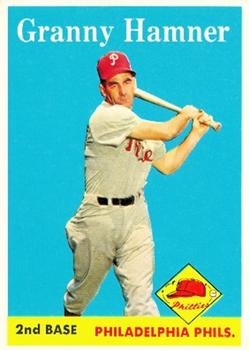
These 1958 Topps cards once had borders, but somewhere along the way somebody decided they looked better without them, so off they went. For reference, I left them in the page they were shipped in. You can see how much smaller they are. And here is one of them in its full, unblemished state:


Bo put a few of these up for trade on his blog. At just about the same time, I bought a lot of vintage cards that were also in somewhat less than mint condition. Coincidentally, I had a couple for his 1969 set build, so I claimed these three obscure former All-Stars for my All-Star project.

I picked up three lots: 1969 Topps baseball, 1977 Topps baseball, and 1975 Topps football. These were some of the keepers for my collection. I'm especially pleased with the variety of football HOF players. But you can see the condition is horrid. We have creases, paper loss, writing, and poor Rico Petrocelli has a chunk taken out. But they work for my collection.

Here is another way to look at the condition of these 40+ year-old cards.

But hey, they landed me a trade with Bo. And if this type of condition doesn't bother you, here is what I have available for trade. I didn't put them for trade on TCDB because I didn't feel good about that. But for you blog readers who have seen what we're dealing with here, I don't mind making a trade if you want some of these old cards. (Links to the TCDB checklist for each set so you can see who the player is.)

1969 Topps: 114, 136, 143, 182, 217, 253, 302, 334, 337, 344, 341, 349, 363, 369, 499, 505

1977 Topps: 5, 20, 26, 178, 294, 310, 356, 474, 526, 545, 562, 597, 607

1975 Topps (FB): 24, 96, 98, 115, 139, 161, 206, 342, 360

If anything is of interest to you, these old clunkers can be yours.

Friday, October 1, 2021

The Franchise 9: Los Angeles Rams


This was a difficult franchise to choose. There have been a lot of great Rams over the years, but interestingly, some Rams Hall of Famers have had shorter stints with the team than other long-time contributors. This left some decisions with a much thinner margin than one might expect. For example, running back Lawrence McCutchen outpaces both Eric Dickerson and Marshall Faulk in career AV. But was he really more impactful in franchise history? What about if you throw in Steven Jackson, who is actually the franchise-leading rusher. Does he knock out another player who is enshrined in Canton? Small decisions like this abounded on this list. Roman Gabriel (who played 11 years for the team) or Kurt Warner (five years)? Tom Mack, Jackie Slater, or Orlando Pace? The result is a very solid lineup with some very solid players on the outside looking in. Here is how my analysis and opinion filled this list.


1. Kurt Warner, QB (2013 Topps Magic)

Back in 1999, the St. Louis Rams were coming off a last-place, 4-12 finish. Sports Illustrated picked them to move up in a weak division--to 3rd place--but still only finish with six wins. Expectations dropped even lower in the preseason when QB Trent Green tore his ACL. Now under center would be former Arena League QB Kurt Warner. The Rams weren't exactly high on Warner; they had left him unprotected in the expansion draft. Apparently, the expansion Browns weren't high on him, either, as they didn't take him. Suddenly, he was the starting quarterback. All he did was act as field general for "The Greatest Show on Turf" and lead the Rams to the only Super Bowl victory in franchise history that very season. He played only 53 games in St. Louis, but he was NFL MVP twice his five-year stint there. He's not in the top five in franchise history in most passing categories (with the exception of passer rating), but he stands out as the best quarterback in team history.

2. Eric Dickerson, RB (2014 Topps Fire)

Eric Dickerson set the NFL single-season rushing record while with the Rams in 1984. That record still stands. That's just part of the story; Dickerson was absolutely dominant for the first six years of his career. In that span, he led the NFL in rushing yards per game every season but one. He led the league in rushing as a rookie in 1983, then his record-setting year of 1984, and again in 1986 (and in 1988, but he wasn't a Ram at that point). He's no longer the team's leading rusher because he was traded halfway through year five. But in 4.5 seasons with LA, he was a Pro Bowler and a 1st-Team All-Pro four times and ran for over 7,200 yards. As a member of the NFL's All-Time Team who spent the best of his career with the Rams, how could he not be part of its Franchise 9?

3. Marshall Faulk, RB (2001 Playoff Contenders)

Marshall Faulk was an all-purpose machine. He joined the Rams fresh off his first Pro Bowl season, having led the league in yards from scrimmage with the Colts. He didn't skip a beat. In his first year in St. Louis (1999), he once again led the NFL in yards from scrimmage while winning a Super Bowl and gaining All-Pro recognition for the first time. For the next two years, he led the league in total touchdowns and was an All-Pro both times. He played seven seasons with the Rams, rushing for 6,959 yards (3rd all-time) and scoring a franchise record 85 TDs.


4. Torry Holt, WR (2008 Gridiron Gear)

In my mind, Torry Holt is WR1a and Isaac Bruce is WR1b in Ram history. Bruce is the franchise leader in catches, receiving yards, and receiving TDs. Holt is close behind in all categories. So why does Holt get the nod here, over Bruce? Because Bruce had 39 more games in a Rams uniform than Holt. The longevity certainly counts for something, but Holt was just more explosive for a shorter period of time. Holt was a seven-time Pro Bowler, one-time All-Pro, and led the league in receiving yards twice. His 117 receptions led the league in 2003, too. Only once in his seven seasons in St. Louis did he fail to reach 1,000 yards--his 32-year-old year, his last the with Rams and the penultimate of his career. He is a member of the NFL's All-2000s team. Isaac Bruce produced for a long time and just took his rightful spot in Canton, but he didn't spend as much time as one of the league's elite as Holt.


5. Orlando Pace, T (1996 Ultra)

The Rams selected Orlando Pace with the first overall pick in the 1996 draft. Three years later, he solidified himself as one of the game's best. During the team's Super Bowl run in 1999, Pace made his first Pro Bowl and his first All-Pro team. It was the first of seven straight Pro Bowls and the first of three All-Pro nods in that span. For his career, he was honored as a part of the All-2000's team and a spot in the Hall of Fame.


6. Aaron Donald, DT (2019 Score Epix Game Red)

Not too many active players are on these lists. Of those active players, Aaron Donald may be the youngest. Donald just turned 30 earlier this year, but he is already ninth all-time in career AV for the Rams. Among active AV leaders, Donald is the only one in the top 25 with fewer than 10 years under his belt. He has played seven seasons, getting Pro Bowl nods in all seven and 1st-Team All-Pro honors in six. In seven seasons, he has taken home the NFL Defensive Player of the Year award three times. The man is a wrecking crew in the middle. And with a long career still ahead of him, he may very well be the one we talk about as the best defensive player in NFL history when it's all said and done.


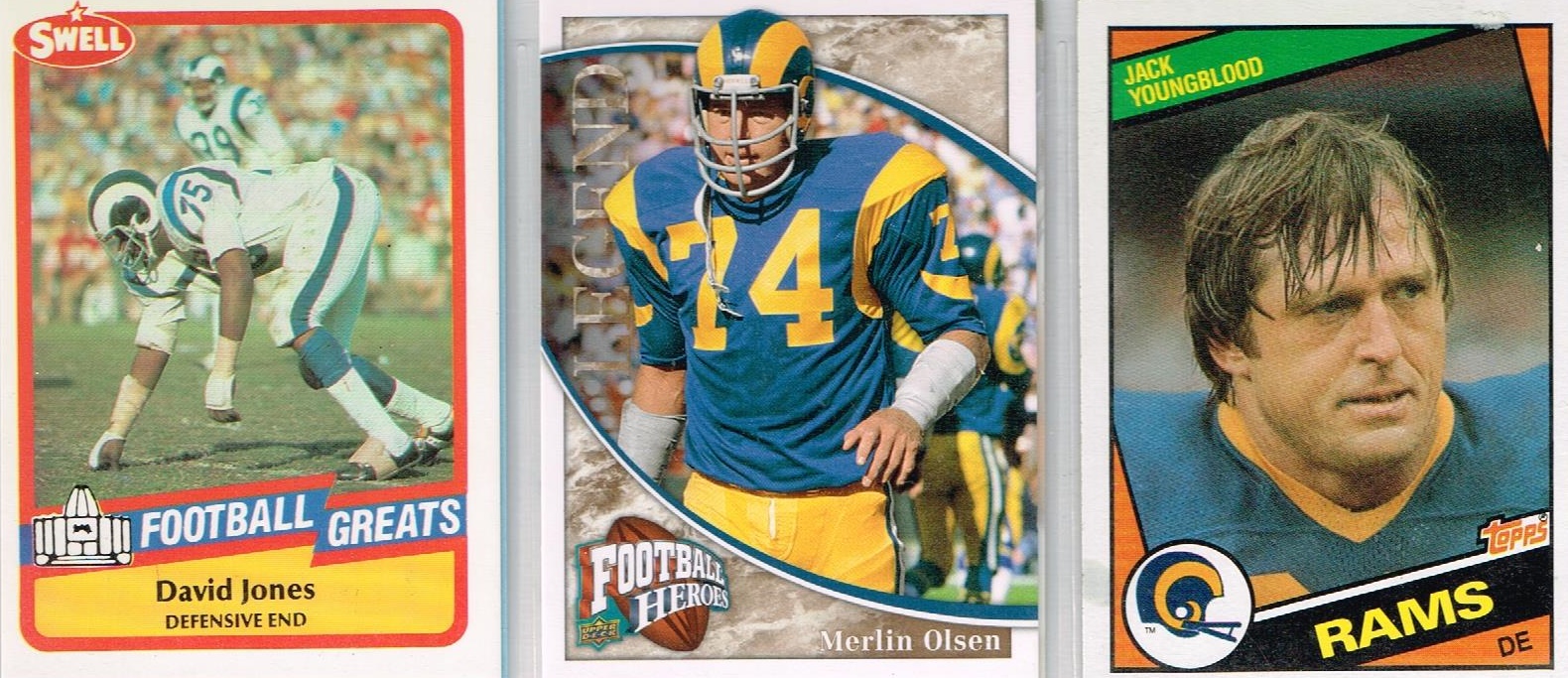
7. Deacon Jones, DE (1989 Swell Football Greats)

David "Deacon" Jones is credited with coining the term "sack" in football. Unfortunately, it didn't become an official statistic until 1982, eight years after Jones's playing career ended, so the original sack-master had no place in the NFL record books. Until 2021. Just four months ago, Pro Football Reference announced the culmination of a painstaking research project in which they credited players with sacks dating back to 1960. Deacon Jones immediately slid into the #3 spot behind Bruce Smith and Reggie White. He was honored as a member of the NFL's 100th Anniversary All-Time Team last year.

8. Merlin Olsen (2009 Upper Deck Football Heroes)

This is Merlin Olsen's second appearance on my blog this year. Many of you are familiar with seeing a certain card of his circulate through the blogs a few months ago. Olsen and Jones made up half of the Rams' "Fearsome Foursome." Olsen also benefited from the new sack stats; he was retroactively awarded 91 sacks, good for third in franchise history. As an illustration of just how dominant he was, consider this: Merlin Olsen had a string of 14 straight Pro Bowls and, within that stretch, five consecutive 1st-Team All-Pro nods. He was a member of two All-Decade Teams and is the third Ram on the NFL's All-Time Team.

9. Jack Youngblood, LB (1984 Topps)

Any reader who is paying close attention will notice that I said Merlin Olsen is third on the team's all-time sack list. So who is second? Aaron Donald hasn't quite caught him. No, #2 is Jack Youngblood, who traveled through the blogosphere with Olsen early this year. Youngblood is now credited with 151.5 sacks and retroactively became the NFL sack leader in 1974 and 1979. He ranks second in Rams' history in approximate value (behind Olsen) and spent his entire 14-year, Hall of Fame with the franchise. Youngblood most definitely belongs with the team's best nine.
 
It's hard for me to look at this list of greats and not feel justified in my decisions. But in some ways, the list is odd because team leaders in key categories such as passing yards and touchdowns, rushing yards, receptions and receiving yards, and interceptions are not here. The team has seemed to have short-lived, superstar streaks combined with steady stat accumulation in its past. I can think of a few more very deserving names, but none that I feel should knock any of these players out of their spots. But I'd love to hear your thoughts. Who are your best Rams?

Some notes on this series:

  1. This includes Super Bowl Era players only.
  2. The "nine" in Franchise 9 is to fill a page in a binder. There is no intent to fill a roster or even a starting lineup.
  3. A player can represent multiple teams.
  4. I tried to find a balance between steady producers with longevity and explosive players with shorter careers. Time with the team does count for something, as does impact with the team.
  5. For a link to Franchise 9 lists that I have already posted, click here.
  6. This is all subjective, so I'd love to hear whom you would choose!


Friday, September 24, 2021

Rookie of the Year Spotlight: Bob Hamelin

Some of the collections I have been working on over the years are starting to get filled out and my goals are being reached. As a result, I'm starting to slow down a little when it comes to acquiring many cards for some of my mini-collections. Now that the collection is feeling more and more complete, I wanted to start showcasing the cards I have, player by player.

One such collection is my Rookie of the Year collection. I love collecting players who have won the award as the top newcomer in each league. This wasn't born of hot rookie hype and the desire to prospect. Rather, I became fascinated thinking about the careers of guys like Eric Karros, Jerome Walton, and Tim Salmon, who experienced varying degrees of success but may not have become superstars. I thought it would be fun to have a collection that chronicles the individual career journeys of rookie stars--whether they burned bright and flamed out quickly, regressed to the mean, or wended their way to Cooperstown.
 
My goal has been to fill a binder page for each player who won the award in my lifetime and to fill a row for older players. I may expand that later as I expand my vintage collection. The ultimate goal of my binder is to show a card from every different uniform the player wore, from fresh-faced rookie to grizzled vet. This series is to commemorate each Rookie of the Year's career and show my collection of their cards. I placed all of the past winners into random.org and got my order. The next player up is:
 

Bob Hamelin


After toiling in the minor leagues for six years, former second-round pick Bob Hamelin got the call to the Majors in 1993. In his first taste of the Bigs, he made 55 plate appearances in 16 games. The results were underwhelming; he slashed .224/.309/.408 with two home runs and 15 strikeouts. In 1994, he was markedly better. He improved his average to .282 and started slugging a few homers. He hit 24 dingers in his first full season, increasing his slugging percentage 191 points and posting a healthy .987 OPS before a strike cut the season short. He won the American League Rookie of the Year easily, taking home 25 of 28 first-place votes. The remaining three first-place votes went to Rusty Greer, who finished third. Sandwiched between them was Cleveland outfielder Manny Ramirez.

Ironically, the 101 games of the strike-shortened season would be the most he would play in a season for the Royals. Over the next two seasons with the club, he would play almost one full slate of games: 161. After a horrendous start to 1995, slashing .168/.278/.313, he was sent back to AAA Omaha. 1996 wasn't much better. After winning ROY, slugger Bob Hamelin would only hit 16 more home runs for KC. He was released during Spring Training in 1997.


He signed with Detroit a month later and bounced back somewhat with the Tigers. He had his best season post-rookie year in 1997, hitting .270 with 18 homers in 110 games. The next year he signed with the Brewers and slumped again. As Milwaukee's regular DH, he put up a paltry .699 OPS with seven home runs. In 1999, he was back in the minors with the Tigers organization when he decided to hang 'em up.
 
Hamelin was a bit of a cult hero during his rookie season, probably due to the fact that he didn't look the part of elite athlete. He looks more likely to finish his shift at the plant and knock back a couple of cold ones while watching the game than to hit home runs on the field at said game. In six Major League seasons, he hit .246 with 67 HR and 209 RBI. Baseball-Reference gives him a WAR of 2.5. It's players like Hamelin that make my ROY collection interesting to me. A player that otherwise would have been largely forgotten by history has one shining breakthrough season and gets the spotlight. The subsequent and varying career trajectories are fascinating to me.

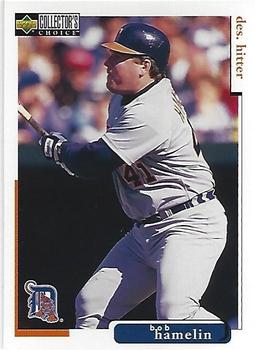
1998 Collector's Choice #89 Bob Hamelin Front

Since I scanned these cards, I've added this Tigers card to my Bob Hamelin page. I still need one to rep the Brewers and complete his career documentation in my collection.